
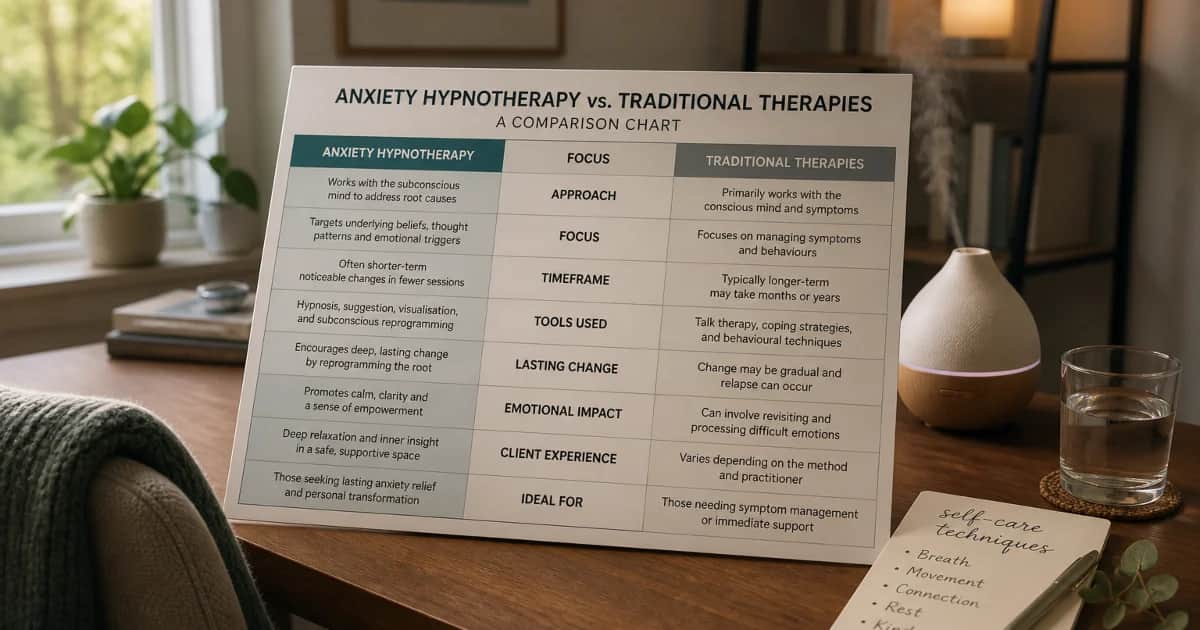
Is Anxiety Hypnotherapy Better Than Traditional Therapies?
The honest answer is: it depends on you. Anxiety hypnotherapy and traditional therapies like Cognitive Behavioural Therapy (CBT), counselling, and medication each have genuine strengths. The right choice hinges on the nature of your anxiety, your lifestyle, your history with treatment, and how your mind best responds to change.
What has become increasingly clear from published meta-analyses and clinical trial evidence is that anxiety hypnotherapy is not an alternative fringe option. It is a clinically supported approach that works at the subconscious level, targeting the automatic worry and stress responses that conscious-level techniques sometimes struggle to shift. For many people, it achieves results that other therapies alone have not.
This comparison is designed to give you a clear, honest look at how anxiety hypnotherapy stacks up against traditional treatments, what each approach actually involves, and how to decide which path fits your needs right now.
Who Should Read This Comparison?
This guide is for you if you are dealing with ongoing anxiety and are weighing up your options. You may already have tried one or more approaches and are wondering whether there is something better suited to how you think and feel. You may be new to treatment altogether and want to understand the landscape before committing to anything.
Specifically, this comparison is most relevant if you:
- Have tried CBT, counselling, or medication but found the results incomplete or temporary
- Understand your anxiety intellectually but struggle to change how it feels in your body
- Want a drug-free, non-invasive option with a strong evidence base
- Are motivated to address the subconscious patterns driving your anxiety, not just manage the surface symptoms
- Are curious about anxiety hypnotherapy but unsure how it compares to more familiar treatments
- Prefer a flexible, personalised approach that works around your schedule and life
It is also worth noting that anxiety is not one thing. Generalised anxiety disorder, social anxiety, panic disorder, health anxiety, and performance anxiety all sit under the same umbrella but respond differently to different methods. This comparison will help you see which approaches tend to work best for which presentations.
Anxiety Hypnotherapy vs. Traditional Therapies: A Detailed Comparison
Below is a breakdown of the most common anxiety treatment approaches, followed by a direct comparison table. The goal is clarity, not hype. Each method has real value; the question is fit.
Cognitive Behavioural Therapy (CBT)
CBT is widely regarded as the first-line psychological treatment for anxiety disorders in most clinical guidelines, including those published by the National Institute for Health and Care Excellence (NICE) in the UK and similar bodies in Australia. It teaches clients to identify and challenge distorted thinking patterns and to gradually face feared situations through structured exposure.
CBT works well for people who are analytically minded, motivated to complete homework tasks between sessions, and whose anxiety is primarily driven by conscious thought patterns. However, it requires consistent effort, multiple sessions over weeks or months, and does not always reach the deeper, automatic fear responses held in the subconscious mind. Some people understand their anxiety perfectly in a CBT framework but find that understanding does not translate into relief.
Medication
Antidepressants (particularly SSRIs and SNRIs) and short-term anxiolytics are commonly prescribed for anxiety. They can significantly reduce symptom severity, especially for moderate to severe presentations, and are often used alongside psychological therapy. The limitations include side effects, the possibility of dependency (particularly with benzodiazepines), and the fact that medication manages symptoms rather than addressing the underlying drivers of anxiety. Benefits can diminish if medication is stopped without accompanying behavioural change.
Counselling and Talk Therapy
General counselling and person-centred therapy provide a supportive space to explore and process anxiety. They are valuable for building insight and emotional vocabulary, and for addressing life circumstances contributing to anxiety. The pace of change can be slower than structured approaches, and the focus tends to remain at the conscious level of understanding rather than driving subconscious change.
Clinical Hypnotherapy for Anxiety
Clinical hypnotherapy works by guiding you into a focused, relaxed state in which the subconscious mind becomes more receptive to therapeutic suggestions. This is not entertainment hypnosis; you remain fully aware and in control throughout. The approach targets the automatic nervous system responses, ingrained worry patterns, and catastrophic thinking loops that generate anxiety, replacing them with calmer, more resourceful responses over time.
Research published across multiple meta-analyses has shown hypnotherapy to produce anxiety reduction effects comparable to or superior to other psychological interventions, with lower dropout rates than many structured programmes. A key advantage is that change happens at the level where anxiety actually operates: below conscious awareness. Sessions also build practical skills, such as deep breathing, relaxation anchoring, and cognitive restructuring, which clients can apply independently in daily life.
At Norwest Wellbeing, clinical hypnotherapy is present-focused and outcome-oriented. It is not about exploring the past for its own sake; it is about retraining the subconscious responses that are maintaining your anxiety right now, and equipping you with the skills to stay calm and confident going forward.
Side-by-Side Comparison Table
| Feature | Anxiety Hypnotherapy | CBT | Medication | Counselling |
|---|---|---|---|---|
| Works at subconscious level | Yes | Primarily conscious | Neurochemical | Primarily conscious |
| Drug-free | Yes | Yes | No | Yes |
| Evidence base for anxiety | Strong (multiple meta-analyses) | Strong (first-line guideline) | Strong (symptom management) | Moderate |
| Addresses root causes | Yes | Partially | No | Partially |
| Side effects | Minimal (relaxation, drowsiness) | Minimal | Common (nausea, weight, withdrawal) | Minimal |
| Requires ongoing commitment | Yes (regular sessions) | Yes (homework + sessions) | Yes (daily dosing) | Yes (ongoing sessions) |
| Suitable for physical anxiety symptoms | Yes (targets nervous system) | Indirect | Yes (direct) | Indirect |
| Can combine with other treatments | Yes | Yes | Yes | Yes |
| Flexible (in-clinic or home use) | Yes (personalised audio available) | Mostly in-person or video | Yes (prescription) | Mostly in-person or video |
| Skills retained after treatment | Yes | Yes | No (effects stop with medication) | Partially |
Where Hypnotherapy Has a Distinct Advantage
Hypnotherapy tends to have the clearest advantage in three situations. First, when anxiety is driven by deeply ingrained, automatic responses that cognitive understanding alone has not shifted. Second, when a person wants a drug-free path that still produces measurable physiological calm, not just intellectual reframing. Third, when flexibility matters: personalised hypnotherapy sessions at Norwest Wellbeing can be delivered as custom audio recordings you use at home, allowing daily repetition that builds new neural pathways far faster than weekly appointments alone.
Research from Norwest Wellbeing's own knowledge base notes that multiple meta-analyses have found hypnotherapy produces effect sizes in the medium-to-large range for anxiety and that these benefits are typically maintained at follow-up. These are the same benchmarks applied to CBT in major trials.
It is also worth noting that hypnotherapy and CBT are not mutually exclusive. Many clients benefit from combining both, using hypnotherapy to reach and retrain subconscious patterns while using CBT frameworks to manage conscious thoughts. If you would like to read more about how to stop overthinking as a related anxiety challenge, that article covers practical strategies that pair well with clinical hypnotherapy. You might also find it useful to read about controlling anxiety and treatment for anxiety for further context on managing anxiety effectively.
Pricing, Inclusions, and What to Expect
Understanding the practical side of each treatment option helps you plan realistically. Here is a general guide based on typical Australian costs and Norwest Wellbeing's current service structure.
Approximate Cost Comparisons (Australia)
- CBT (psychologist): $250 to $350+ per session; Medicare rebates available with a GP Mental Health Care Plan (typically 10 sessions per calendar year)
- Medication: Ongoing prescription costs; variable depending on medication type and health cover
- Counselling: $100 to $250 per session; some rebates may apply
- Norwest Wellbeing in-clinic hypnotherapy: $300 per session; face-to-face or on Zoom with a qualified clinician: some private health rebates may apply, check with your provider
What Is Included in Hypnotherapy at Norwest Wellbeing?
- A detailed intake assessment to personalise your session to your specific anxiety type, triggers, and goals
- Professional studio-quality recordings
- Therapeutic techniques including relaxation anchoring, cognitive restructuring, nervous system retraining, and positive suggestion
- The ability to repeat your session daily for deeper subconscious reinforcement
- Support from qualified clinical hypnotherapists Paul and Rebecca Smith
The recordings are particularly cost-effective compared with multiple therapy sessions, because you can listen daily rather than waiting a week between appointments. This repetition is clinically significant: it builds new neural pathways more efficiently, which translates to faster and more durable anxiety relief.
Ready to find out what approach is right for you? Explore our anxiety hypnotherapy service to learn more or book your initial consultation.
Get Started with Anxiety Hypnotherapy
If you have been living with anxiety and feel you are ready for an approach that works at a deeper level than willpower or talking alone, clinical hypnotherapy could be the missing piece. You do not have to stop other treatments to benefit; hypnotherapy integrates smoothly alongside CBT, medication, or counselling.
At Norwest Wellbeing, we work with adults and children across Sydney and Australia-wide. Every session is built around your unique situation, not a generic script. Our clinicians, Paul and Rebecca Smith, bring specialist training in anxiety, stress, and subconscious behaviour change to every client they work with.
"After years of managing anxiety with medication and CBT, I finally felt like something was changing at a level I could not previously reach. The sessions helped me feel calm in situations that used to trigger me every time."
Client experience shared in the spirit of Norwest Wellbeing's client outcomes; individual results vary.
The first step is simple. Visit our anxiety hypnotherapy page to learn about our approach, browse session options, and book a free 15-minute consultation to discuss your needs. There is no obligation; just a conversation about what is possible for you.
Anxiety is treatable. With the right support, you can retrain the automatic responses that have been holding you back and rediscover your natural capacity for calm, confident living.
Ready for tailored support?
Book a complimentary consultation with the Norwest Wellbeing team.
We'll talk through your goals, match you with the right practitioner, and outline the first steps to lasting change.
More resources to explore
View all articles →
PTSD Hypnotherapy vs. Traditional Approaches: Which Is Better?
EMDR and trauma-focused CBT are the first-line, evidence-based PTSD treatments, usually with a clinical psychologist; medication may also help via a psychiatrist. Hypnotherapy is a complementary...
How to Prepare for Your First PTSD-Support Hypnotherapy Session
Confirm you have a PTSD diagnosis or assessment, and ideally are already engaged with a psychologist or psychiatrist for trauma-focused treatment, before treating hypnotherapy as a complementary...

Myths About Hypnotherapy for PTSD: Debunking Common Misconceptions
The biggest myths about hypnotherapy for PTSD are that it can cure trauma alone, that it requires reliving traumatic events, and that it can replace EMDR or medication. In reality it's a...